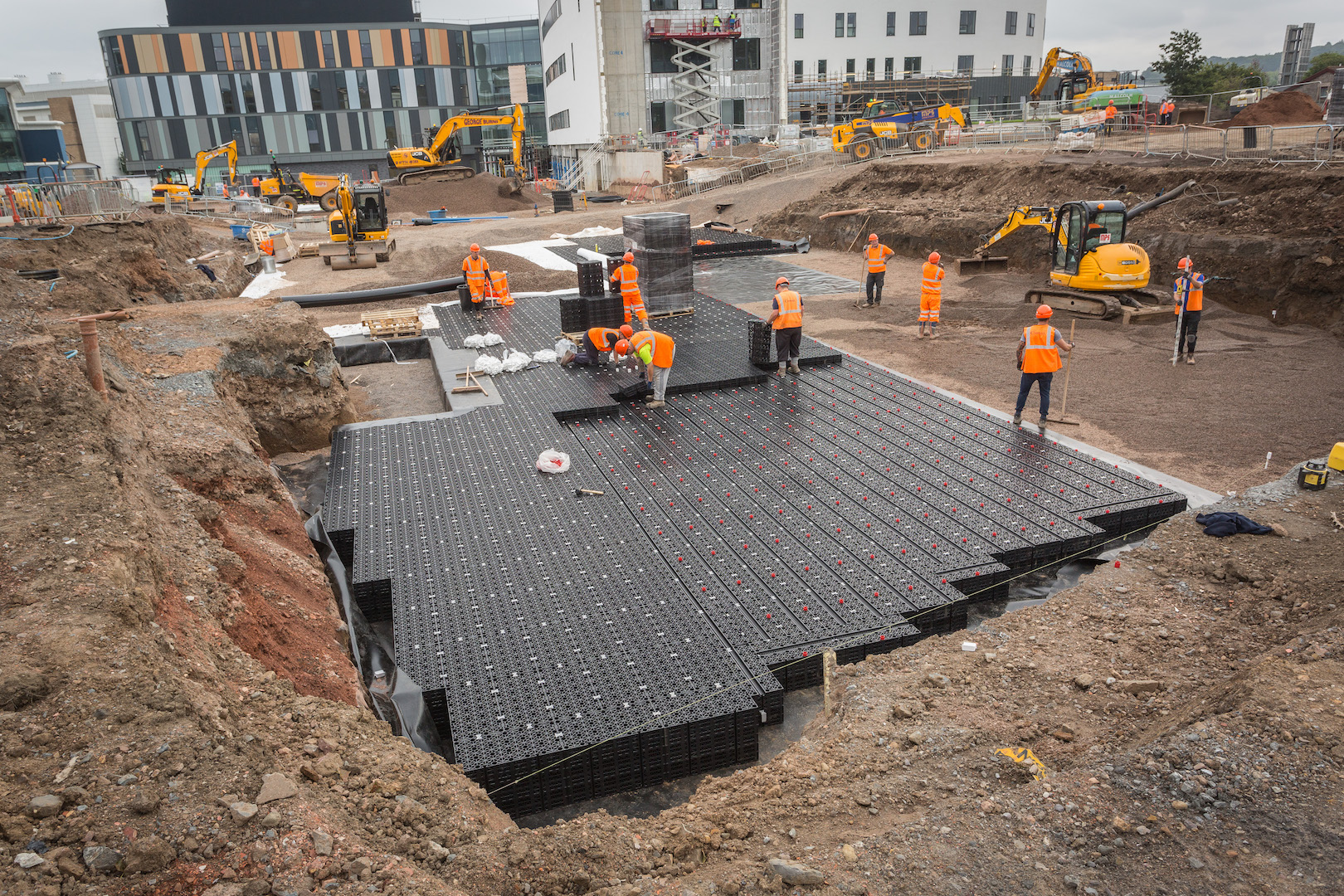
Over 300,000 of Polypipe Civils & Green Urbanisation’s [Polypipe CGU] Permavoid and Polystorm-R modular cells for water attenuation have been installed across the new £150million site of the Royal Hospital for Children and Young People in Edinburgh.

The hospital complex at Little France will provide the Royal Hospital for Sick Children, the department of clinical neurosciences and the child and adolescent mental health services with a purpose-built location that consolidates three key departments on one central site in the city.

Polypipe CGU, working with primary contractor Multiplex, supplied 11 shallow geocellular attenuation tanks that hold a combined volume of up to 2020m³.

The tanks were installed under parking bays and beneath crucial entrances, including the hospital’s A&E. An intelligent sub-base replacement design was needed to store the appropriate level of water, above the high water table, that gathers on the site during heavy rainfall. Following discussions with Polypipe CGU’s technical team, the project consultant engineer chose the Permavoid geocellular system as the primary engineered solution.

Edinburgh Childrens Hospital


The tanks were installed under parking bays and beneath crucial entrances, including the hospital’s A&E. An intelligent sub-base replacement design was needed to store the appropriate level of water, above the high water table, that gathers on the site during heavy rainfall. Following discussions with Polypipe CGU’s technical team, the project consultant engineer chose the Permavoid geocellular system as the primary engineered solution.

The Permavoid tanks were placed beneath permeable paving and non-permeable paving, wrapped in geomembrane to make them watertight for attenuation. Permatex, a polypropelene geotextile, was installed between the Permavoid layers to ensure passive water infiltration into the tanks. Demonstrating how the breadth of Polypipe CGU’s range can provide a solution for any challenge, 10 of the tanks installed used Permavoid 150mm to hold a volume of up to 1780m³, with one tank using a combination of Polystorm-R with Polystorm Access and Polystorm Inspect, supplying a further 240m³ volume tank.

With adjoining hospital departments needing to remain open and accessible during construction, a carefully coordinated delivery schedule for the products on-site needed to be devised between Polypipe CGU, the selected Merchant (PDM), and the on-site project managers to minimise disruption to patients and medical staff.

Permavoid - Public Non-Housing - Attenuation - Edinburgh Hospital - Image 3.jpg

Jonathon Mays, Procurement Manager at Multiplex, said: “Polypipe CGU was a clear choice for this project as their technical experts were able to assess on-site requirements and define the right products and quantities needed. By working with merchant partner, PDM, the easy-to-install Permavoid and Polystorm-R systems could be delivered to site on a timely basis and quickly put into position. Using a geocellular system also reduced the amount of land that needed to be excavated from the site.”

Glynn Irvine, Senior Civil Engineer at Robert Bird, said: “Planning conditions set by SEPA, due to the proposed finished flood level of the building below site wide flood levels, required Greenfield discharge rates for the proposed development. This resulted in a maximum discharge rate of 12.1 litres per second during the 1:200 year return period, with controlled flooding controlled during the 1:1000 year return period. An integrated SuDS strategy was proposed at the site which required a significant amount of below ground attenuation within external spaces.

“Overall, the attenuation system designed by Robert Bird enabled the stringent planning conditions to be met, while utilising the many benefits of the versatile Polypipe CGU product. Robert Bird Group specified Permavoid throughout the site, within both permeable car parking areas and impermeable hardstanding areas as sub-base replacements due to the very shallow site-wide outfall, which needed to be retained.

“The Permavoid was also specified under areas trafficked by 40 tonne cranes due to its ability to withstand the anticipated strenuous loading. Polypipe CGU undertook structural checks to ensure that the Permavoid met the site loading conditions throughout both construction and final design, which was a great assistance to the design and construction team.”